
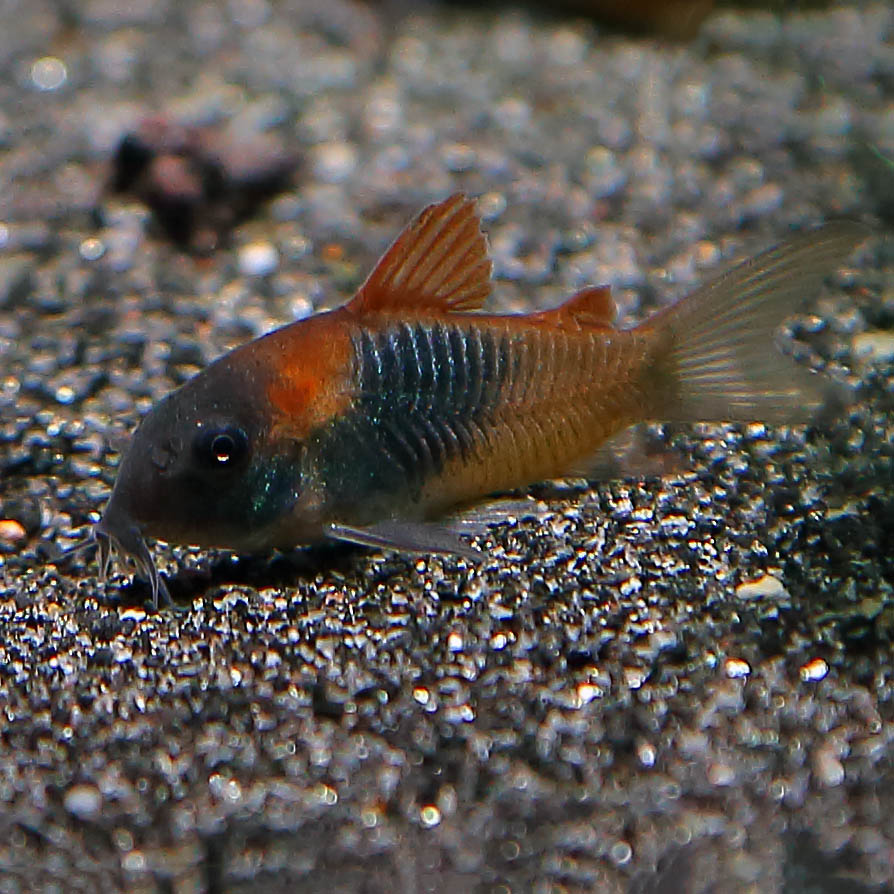
Orange Venezuelan Corydora is listed under the scientific or trade designation Corydoras venezuelan. It should be selected for its adult requirements and natural behaviour, not simply for its colour or the size offered in store. The catalogue record places it in freshwater habitats associated with the verified species. Individual fish may vary in colour, pattern and finnage with age, sex, locality and captive breeding, so the product photograph should be treated as a representative example.
Orange Venezuelan Corydora care
- Adult size: confirm the adult size for the exact form before purchase
- Temperature: use the verified species range and avoid sudden changes
- pH: match the verified species’ natural-water preference and keep it stable
- Care level: Easy to moderate once kept in a mature, well-filtered aquarium with the correct diet
Aquarium setup
Provide a clean, mature aquarium with excellent oxygenation and easy access to suitable sinking food. Smooth substrate protects bottom-dwelling fish, while caves and wood give nocturnal or territorial species somewhere secure to rest. Stability matters more than chasing an exact number. Cycle the aquarium fully before adding livestock, maintain regular partial water changes and avoid sudden changes in temperature, pH or mineral content. Use a filter sized for the final stocking level and keep nitrate and other waste products under control. The short care panel gives the best available species-specific range; where a reliable KH figure is not published, match the fish’s natural-water preference and keep alkalinity consistent.
Feeding
Use appropriate sinking foods and add frozen or fresh items suited to the species; do not rely on leftovers alone. Offer portions the fish can finish promptly and vary the diet rather than relying on one food. Bottom-dwelling or shy fish must be observed to make sure food reaches them after more confident tank mates have fed. Remove uneaten food before it affects water quality.
Behaviour and tank mates
Peaceful and social; Corydoras-type catfish should be kept in a proper group on a smooth substrate. Check the verified adult size of every tank mate, and avoid combinations where one fish is small enough to be swallowed or too slow to compete. When the listing is a colour form, locality form, hybrid or L-number fish, base compatibility on the parent species or confirmed taxon rather than the sales name alone. Observe new livestock closely during the settling-in period and be ready to separate fish if sustained chasing, fin damage or feeding problems occur.
A secure lid is recommended because unfamiliar surroundings can make many tropical fish jump. Quarantine new arrivals where possible, and never release aquarium livestock into the wild.
Glenn Stokes –
Orange Venezuelan Corydora
I have 3 of the above Fish in my tank very active fish very good clean up crew and a good friendly community fish well recommended
Ashleigh Bevan (verified owner) –
Lovely little fish,very active settled in well
Ray ward (verified owner) –
Just received 4 of these great little fish, settled in straight away into my corry tank, they all get along amazingly well
Matt Timpson –
Bought 6 of these wonderful little Cory’s in store last week for my 240 Litre tank. In perfect condition and settled in immediately. Busy and incredibly active fellas, and quite possibly my new favourite Cory (and I’ve had many kinds over the
years)
Susan Parish (verified owner) –
Lovely fish and arrived in good condition very busy little fish, eating well, I bought 6 of these to add colour to the tank, it’s starting to look nice, plants are growing and these little guys can hide and play in them.
Chris Tinson –
Stunning little Cory’s. Nice colours on them already and looking forward to seeing them develop further.