

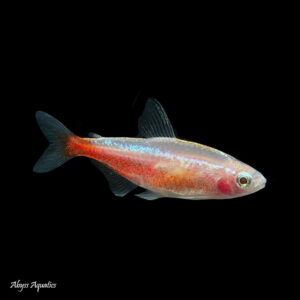
Blue Emperor Tetra (Inpaichthys kerri) is an attractive freshwater tetra suited to a carefully planned community aquarium. Males develop a stronger blue sheen, while females often show warmer colour in the adipose fin.
Appearance and natural habitat
Aripuanã drainage of the upper Madeira River basin in Brazil. The species is best displayed in an aquarium that combines planted or shaded cover with clear swimming space. A darker background usually helps reflective scales and coloured fins stand out, while a secure lid is sensible for active tetras.
Keep the aquarium fully cycled and introduce the fish only when ammonia and nitrite remain at zero. Stable conditions are more important than chasing an exact number with sudden chemical adjustments.
Blue Emperor Tetra care
- Adult size: Up to 3.5 cm
- Temperature: 24-27°C
- pH: 5.5-7.0
- KH: 1-8 dKH; soft to moderately soft water is preferred
- Care level: Easy to moderate
- Lighting: Low to moderate, with plants and a dark background
Aquarium setup
Peaceful shoaling fish; keep at least 6, with 8-10 preferred. Use plants, wood or other décor to create visual shelter while preserving an open route for the group to swim. Regular partial water changes, an established filter and steady temperature will help maintain colour and appetite.
A proper group is important: tetras kept in insufficient numbers may hide, lose colour or direct normal social behaviour towards unsuitable tank mates. Choose companions with a similar adult size and temperament, and avoid fish large enough to regard them as food.
Feeding and tank mates
Feeding: Fine flakes or micro pellets with small frozen foods such as daphnia, cyclops and brine shrimp. Offer small portions once or twice daily and vary the diet so that every fish receives food without excess reaching the substrate.
Compatibility: Observe the group after introduction and at feeding time. Calm community fish, small catfish and other appropriately sized shoaling species are usually the best companions. Check the listed water ranges against the other inhabitants before mixing species.


Reviews
There are no reviews yet.